
PostSharp [MVVM]
Eliminate the INotifyPropertyChanged boilerplate and more.
- Stop losing time writing boilerplate for INotifyPropertyChanged, commands, dependency properties, undo/redo, ...
- Never forget a PropertyChanged notification again.
- Keep your business logic clean.
![PostSharp [MVVM]](/assets/images/postsharp/heroes/mvvm-fb0d00c2a0.png)
INotifyPropertyChanged
[NotifyPropertyChanged]
public class CustomerViewModel
{
    public CustomerModel Customer { get; set; }

    public string FullName
    {
        get
        {
            // Change in Customer, Customer.FirstName or
            // Customer.PrincipalAddress.Line1 will trigger the event.
            return string.Format("{0} {1} from {2}",
                Customer?.FirstName,
                Customer?.LastName,
                Customer?.PrincipalAddress?.FullAddress);
        }
    }
}
Get rid of the INotifyPropertyChanged boilerplate and never miss a notification again.
- Support for composite properties and child objects
- Consistent and reliable
- Fully customizable
- Integrates with other MVVM frameworks: MVVM Light and Caliburn.Micro
Command
[NotifyPropertyChanged]
public partial class MainWindow : Window
{
    bool isReadOnly;

    [Command]
    public ICommand SaveCommand { get; private set; }

    private void ExecuteSave()
    {
        // Details skipped.
    }

    public bool CanExecuteSave => !this.isReadOnly;
}
Stop creating a class every time you define a command.
- Easy, based on custom attributes and naming conventions.
- Validated at build time.
- CanExecute property integrates with the [NotifyPropertyChanged] aspect.
Dependency & Attached Properties
public partial class FancyTextBlock : UserControl
{
    public FancyTextBlock()
    {
        InitializeComponent();
    }

    [DependencyProperty]
    [Required]
    public string Text { get; set; } = "Hello, world.";

    [DependencyProperty]
    public Brush FancyBorderBrush { get; set; }

    public void OnFancyBorderBrushChanged() { /* Handle changes here. */}
}
Dependency properties that still look like properties.
- Support for composite properties and child objects.
- Consistent and reliable.
- Fully customizable.
- Integrates with PostSharp code contracts.
- Integrates with other MVVM frameworks.
Code Contracts
public interface IReferralService
{
    [return: Required]
    Referral CreateReferral(  [Required] string name, [Url] string url);
    }

public class ReferralService : IReferralService
{
    public Referral CreateReferral( string name, string url )
    {
        // Contracts are automatically inherited from the interface.
    }

    [Required]
    public string ConnectionString { get; set; }
}
The most readable way to validate values at run time.
- Works with parameters, output parameters, return values, fields, and properties.
- Works on interfaces and abstract methods. Automatically inherited.
- As fast as hand-written code.
- Customizable and localizable exception messages.
- Integrates with the [DependencyProperty] aspect.
Weak Event
static class MyEventSource
{
    [WeakEvent]
    public static event EventHandler MyEvent;
}

class MyEventClient
{
   public MyEventClient()
   {
      MyEventSource.MyEvent += (sender, e) => Console.WriteLine( "Oops!" );

      // No need for IDisposable and handler unregistration.
   }
}
Avoid the most common source of memory leaks in .NET.
- As simple as a custom attribute.
- Apply to all events in your project in a single line.
Undo/Redo
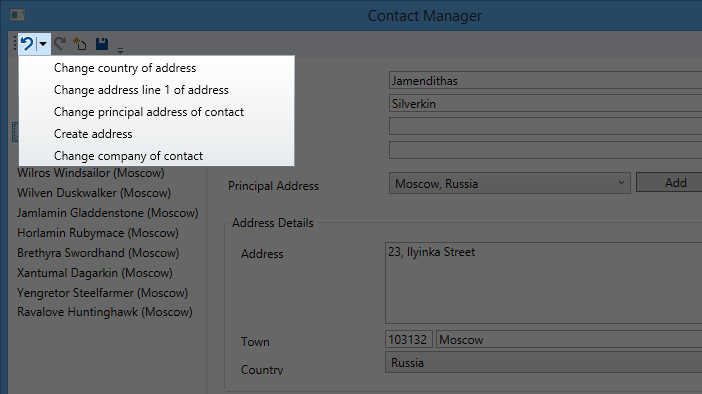
Give your users the familiar Undo/Redo experience without breaking the bank.
- Undo/Redo any object state change.
- Handle multiple changes as one step.
- Expose in the UI with built-in or custom controls.