
Any .NET Project, With or Without Metalama
Every exchange below is a real session against MediatR, a project that has never referenced Metalama. The first prompt loads it:
Load src/MediatR/MediatR.csproj.
load_workspace
MediatR is loaded: one project, built for net6.0 and netstandard2.0, with no load errors.
The server loads .csproj, .sln, .slnx and .slnf files with MSBuild and Roslyn, and exposes them through the same code model that Metalama aspects and fabrics use. Your projects do not need to reference Metalama. Multi-targeted projects load once per target framework, so the agent can tell you what differs between them. When your projects do use Metalama, the agent sees more: the aspect instances, the advice, and the transformed code that the aspects produce.
Asking Questions About the Code
The server exposes five tools: load_workspace, reload_workspace, unload_workspace, query and open. A query is a C# expression, or a block of statements ending with return, written against the same API as our LINQPad driver. You do not write the queries yourself: you ask in plain English, and the agent writes them.
Which classes implement an interface?
Which types in MediatR implement IPipelineBehavior?
query
workspace.GetProject( "MediatR", "net6.0" ).SourceCode.Types
    .Where( t => t.AllImplementedInterfaces.Any( i => i.Name == "IPipelineBehavior" ) )
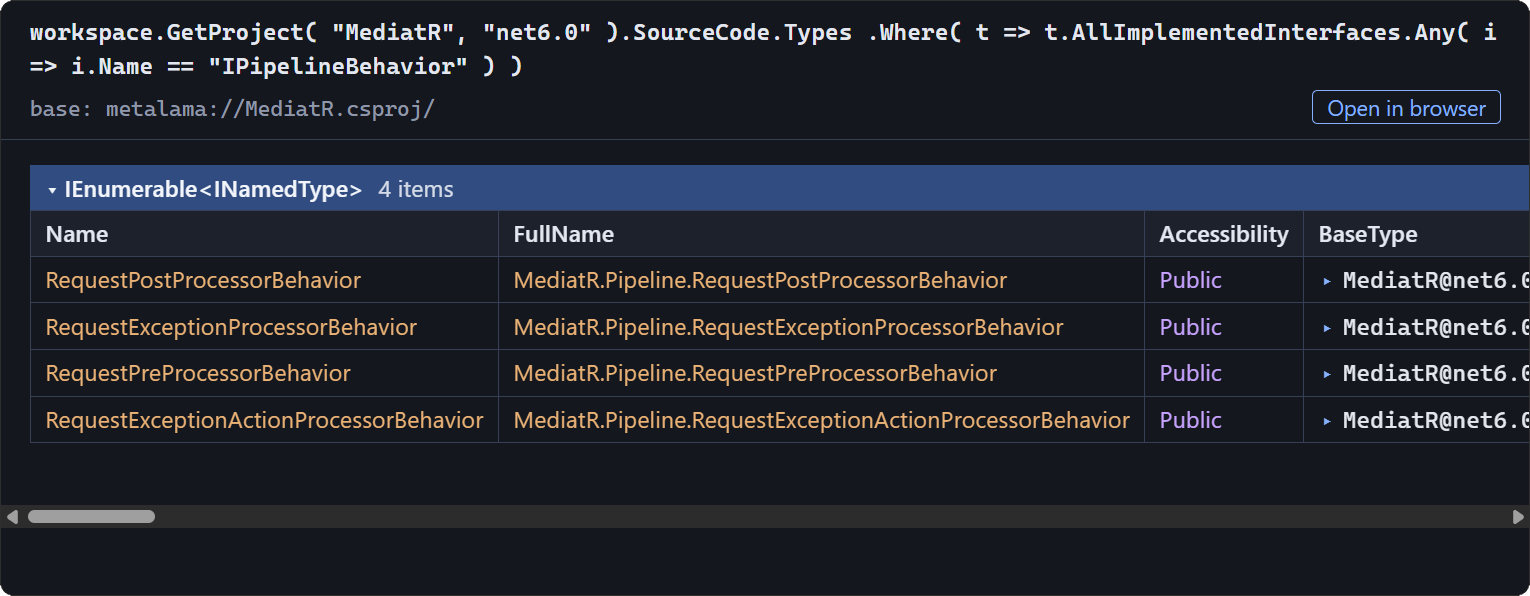
Four types implement IPipelineBehavior<TRequest, TResponse>, all in MediatR.Pipeline: the pre-processor, post-processor, exception-processor and exception-action-processor behaviors.
AllImplementedInterfaces includes the interfaces inherited from base types, which no text search can give you. Behind the widget, the agent receives each declaration with a link it can pass back to the open tool to drill down, and a file:line location it can read with its own file tools.
Who uses this type?
Where is IMediator used, and how?
query
D<INamedType>( "T:MediatR.IMediator", project: "MediatR", tfm: "net6.0" )
    .GetInboundReferences()
    .Select( r => new { r.OriginDeclaration, r.Kinds } )
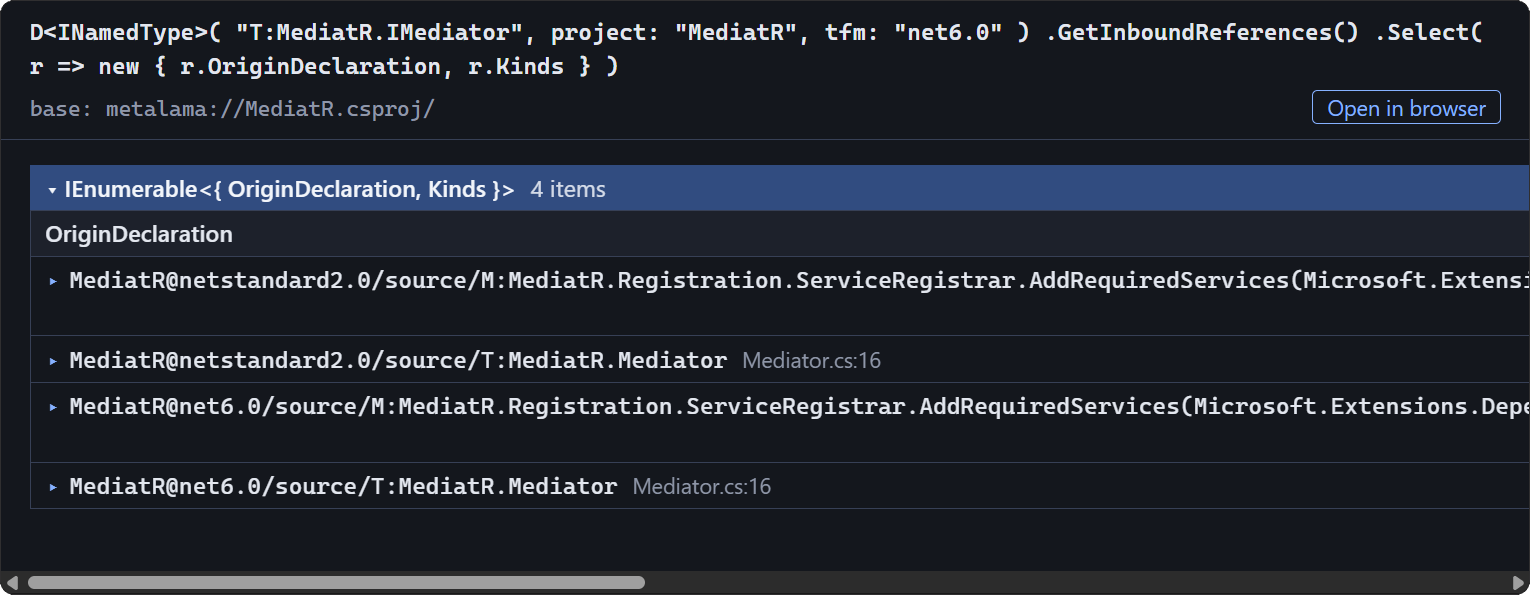
IMediator is used in two places, in both target frameworks: Mediator implements it, and ServiceRegistrar.AddRequiredServices registers it in the service collection, with typeof(IMediator) and as the type argument of GetRequiredService<IMediator>().
The references come with their kind, so the agent tells an implementation from a registration without opening the files. GetOutboundReferences() answers the reverse question, and GetDerivedTypes() walks the inheritance tree.
Where is the complexity?
Which five types have the most methods? Give me their method and property counts.
query
workspace.GetProject( "MediatR", "net6.0" ).SourceCode.Types
    .OrderByDescending( t => t.Methods.Count )
    .Select( t => new { Type = t, Methods = t.Methods.Count, Properties = t.Properties.Count } )
    .Take( 5 )
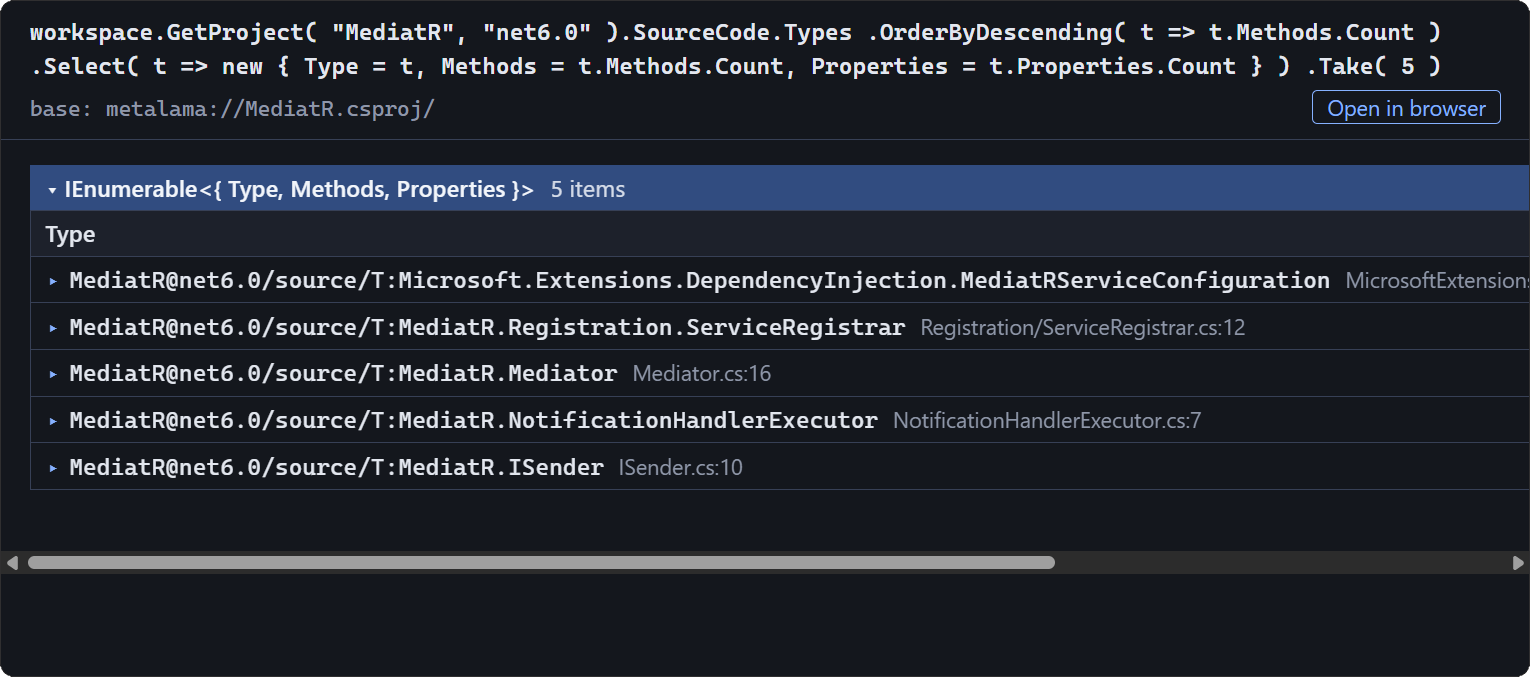
MediatRServiceConfiguration leads with 26 methods and 17 properties, ahead of ServiceRegistrar with 19 methods. No other type has more than 9 methods.
The workspace was loaded once, so follow-up queries take milliseconds. Projections to anonymous types render as tables, and declarations keep their links.
The Interactive HTML View
Text output is for the agent. For you, there is a browser view:
Show me this list in my browser.
query with format: html
Here it is: https://localhost:53271/…/r/HuYiYdCC7GdXNPhW. The link works as long as the MCP server is running.
The page works much like LINQPad:
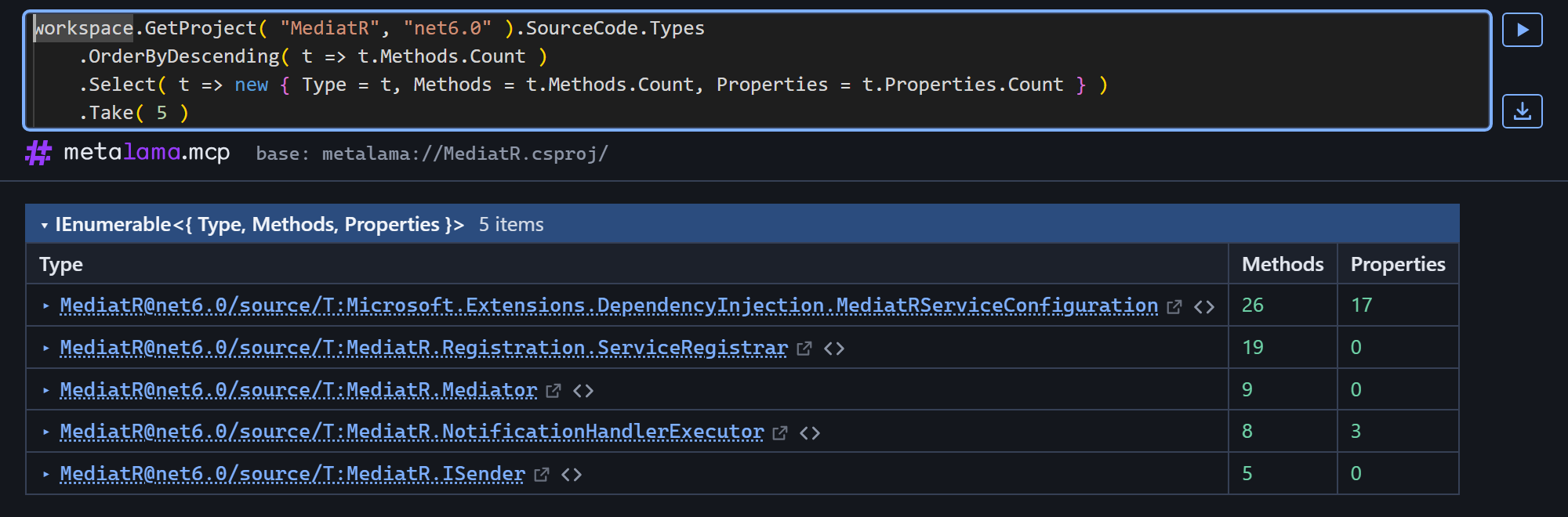
- Sort and filter. Click a column header to sort; the Filter box keeps the rows that contain a text.
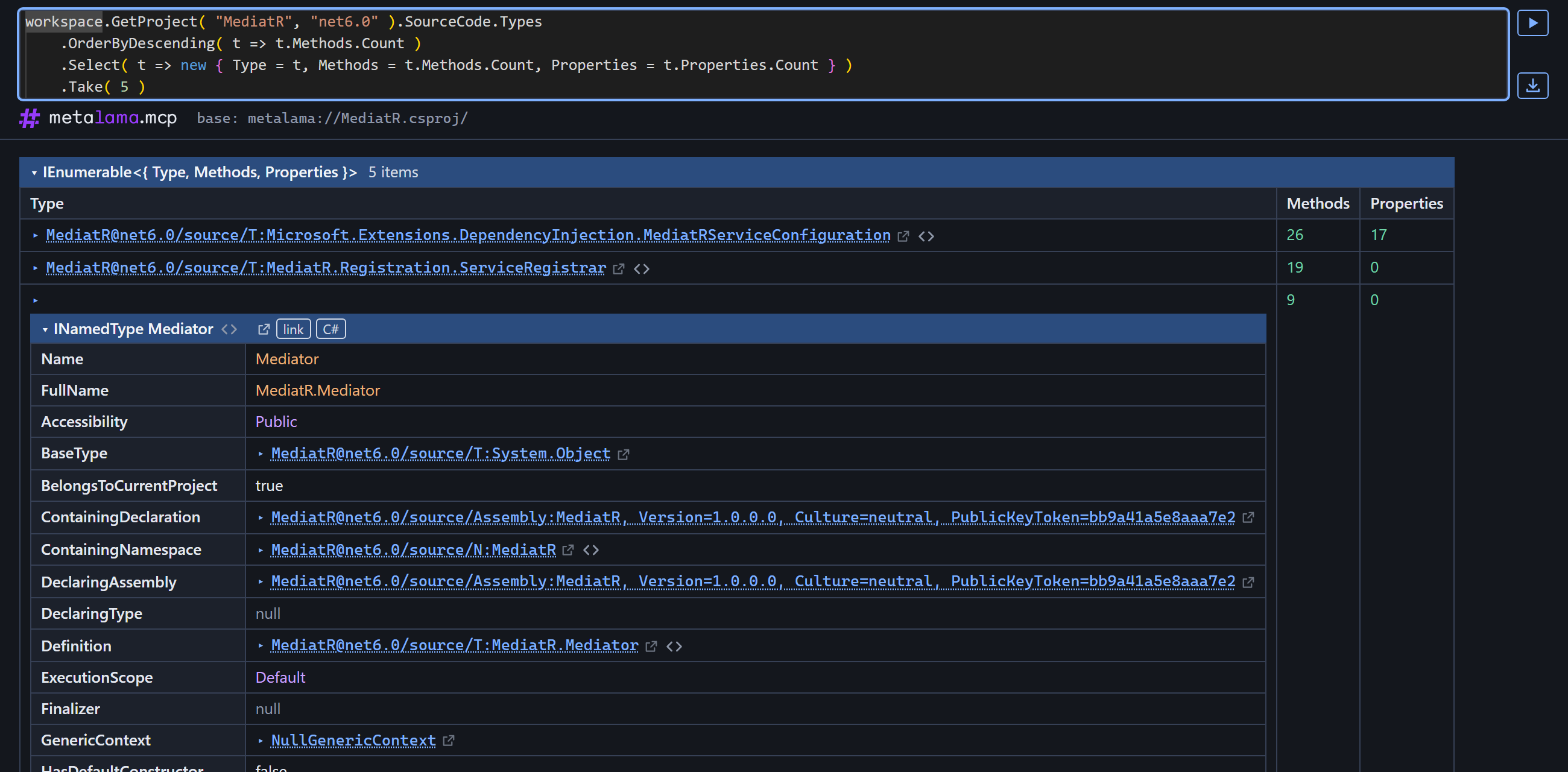
- Expand on demand. Click a declaration to expand its properties in place. Values are loaded from the server as you click, so you can walk from a type to its methods, to their parameters, to their references.
- Jump to the source. One icon opens the declaration on its own page, the other opens the source file at the right line in your editor.
- Hand back to the agent. The link button copies the link the agent accepts, and the C# button copies a C# expression that resolves the declaration in a query.
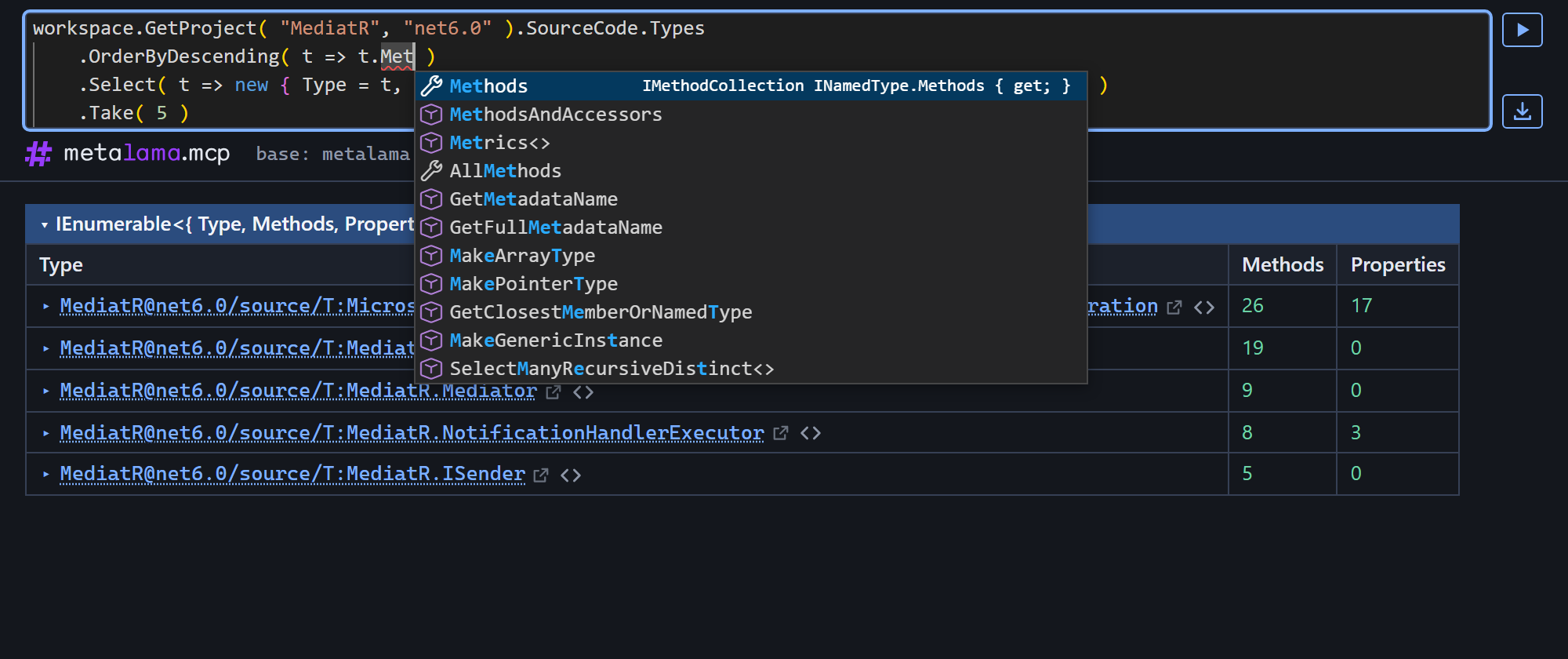
The query at the top of the page is editable. It has completion, tooltips, parameter hints and error underlines, and Ctrl+Enter runs it again. The agent writes the first draft of the query; you refine it yourself.
A download button saves a snapshot of the page that works without the server.
Agents that support MCP Apps, such as Claude, show results inline in the conversation, as in the replies above. Once a result has been shown in the browser, the widget gets an Open in browser button that takes you to the full page.
Inspecting the Aspects of a Metalama Project
When a project uses Metalama Framework, the agent also sees its aspects: which ones are applied, where, and what they changed. Our own example is the web application behind our store and customer portal. Its nine projects use Metalama Patterns for caching and contracts, plus three aspects of our own.
Which aspects are used?
Load our web application and tell me which aspects it uses, and how often.
load_workspace
query
workspace.AspectClasses
    .Where( c => c.Instances.Any() && !c.FullName.StartsWith( "Metalama.Framework" ) )
    .OrderByDescending( c => c.Instances.Count() )
    .Select( c => new { Aspect = c, Instances = c.Instances.Count() } )
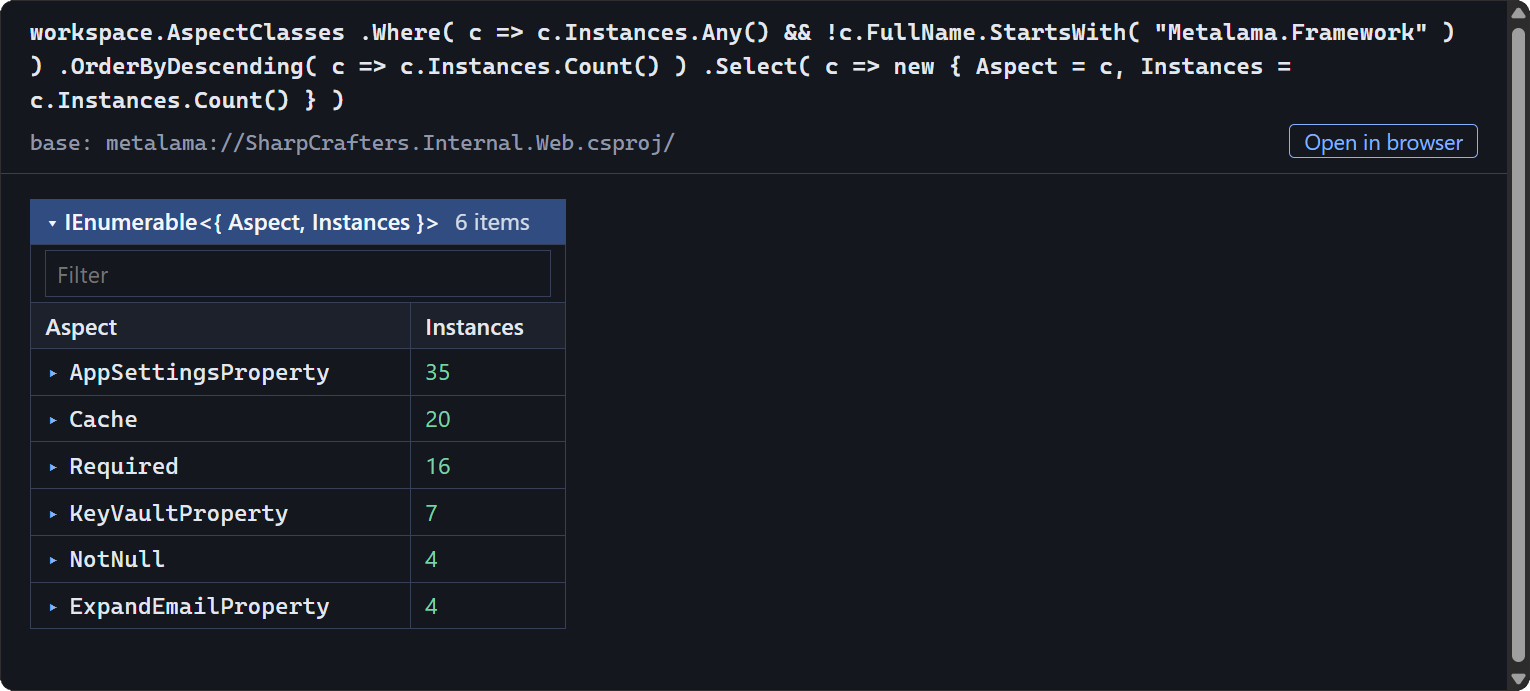
Six aspects, applied 86 times. Three are your own: [AppSettingsProperty] (35), [KeyVaultProperty] (7) and [ExpandEmailProperty] (4) bind properties to application settings, Key Vault secrets and e-mail placeholders. The other three come from Metalama Patterns: [Cache] (20), and the [Required] (16) and [NotNull] (4) contracts.
The filter on Metalama.Framework leaves out the aspects that Metalama creates for its own needs.
Where is this aspect used?
Where is [Cache] used?
query
workspace.AspectInstances
    .Where( a => a.AspectClass.ShortName == "Cache" )
    .Select( a => a.TargetDeclaration )
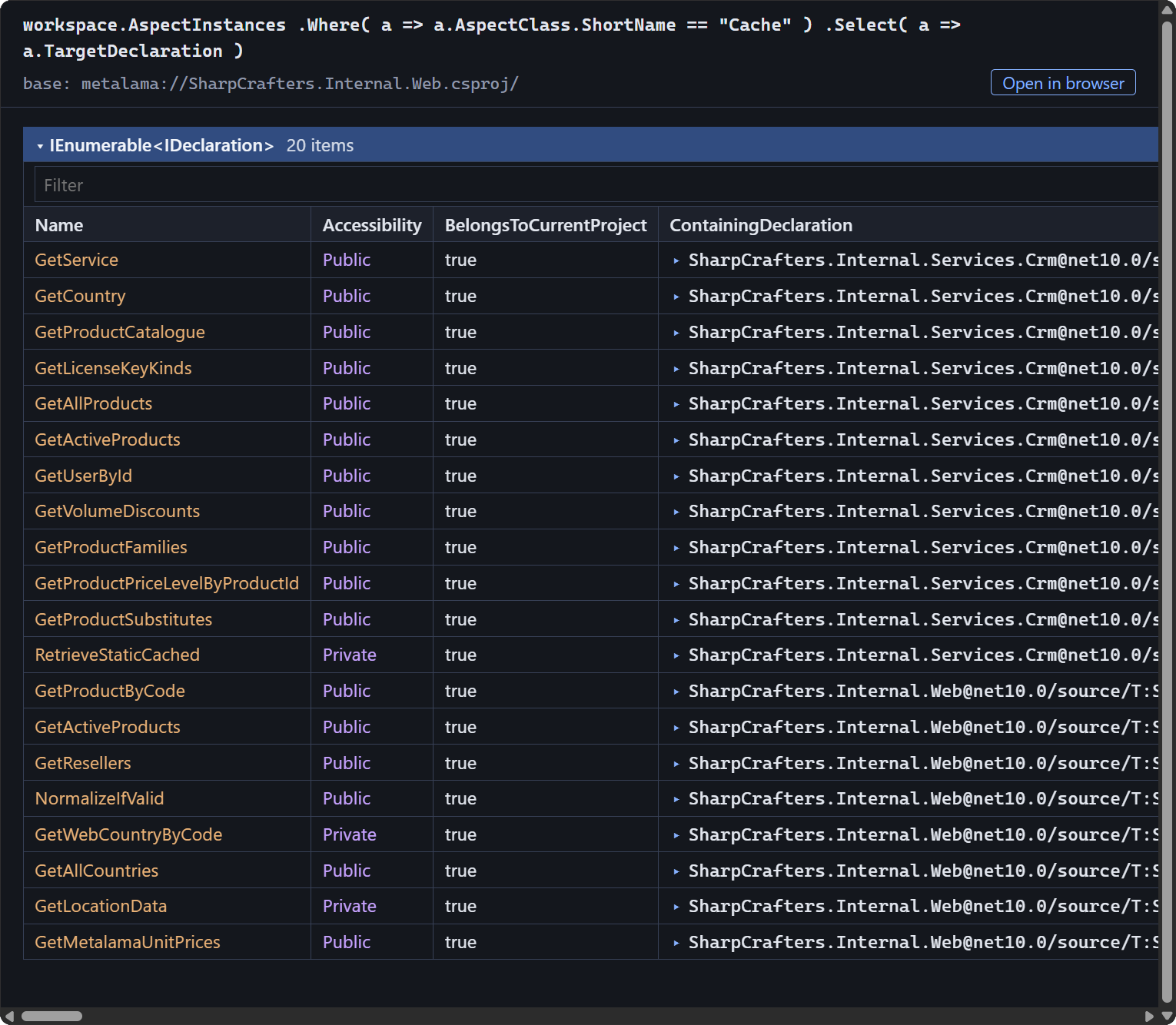
On 20 methods. 12 are in CrmFacade, which caches the CRM lookups: products, prices, discounts, countries and users. The other 8 are in the web application itself: the product and account services, the GeoIP and VAT lookups, the country list, and the Metalama unit prices.
Each aspect instance also knows what created it, the advice it added, and the code it produced: the agent can follow it into TransformedCode to show you a method as it compiles, with the caching in place.
What the Agent Can Query
The workspace object exposes:
- Source code:
SourceCode.Types,Methods,Fields,Properties,Constructors,Events, across all projects and target frameworks. - References:
GetInboundReferences(),GetOutboundReferences()andGetDerivedTypes(). - Diagnostics: the compiler warnings and errors, and the load issues of the workspace.
- Metrics: from
Metalama.Extensions.Metrics, such as the number of syntax nodes of a method. - For Metalama projects:
TransformedCode,AspectClasses,AspectInstances,AdviceandTransformations.
The agent finds its way through this object model on its own, but you can read it too: see the Introspection API reference.
Getting Started
The server is the metalama-mcp .NET tool. It requires the .NET 10 SDK or later.
dotnet tool install -g Metalama.Mcp
With Claude Code:
claude mcp add metalama -- metalama-mcp
Other agents, such as GitHub Copilot and Cursor, take the same command in their MCP configuration. Start the agent from your repository directory, because the server resolves relative paths against its working directory. For the browser view, trust the .NET development certificate once:
dotnet dev-certs https --trust
The MCP server is part of Metalama 2027.0, currently in preview. See Using the MCP server for the details.